
By Joseph Gillingham, Heritage Tree Care Inc. | Updated September 2026
Key Takeaways
Trees touching or growing close to overhead wires can create a serious electrical hazard, even when the line appears insulated or inactive.
- Keep away from fallen trees, branches, and wires, and call the utility for immediate hazards.
- Do not attempt tree cutting near power lines with household tools or ladders.
- Confirm who owns or controls the line before arranging any trimming or removal.
- Check Toronto permit requirements before removing a protected tree.
- Have a qualified arborist assess leaning, damaged, dead, or fast-growing trees early.
Why Tree Cutting Near Power Lines Is More Dangerous Than It Looks
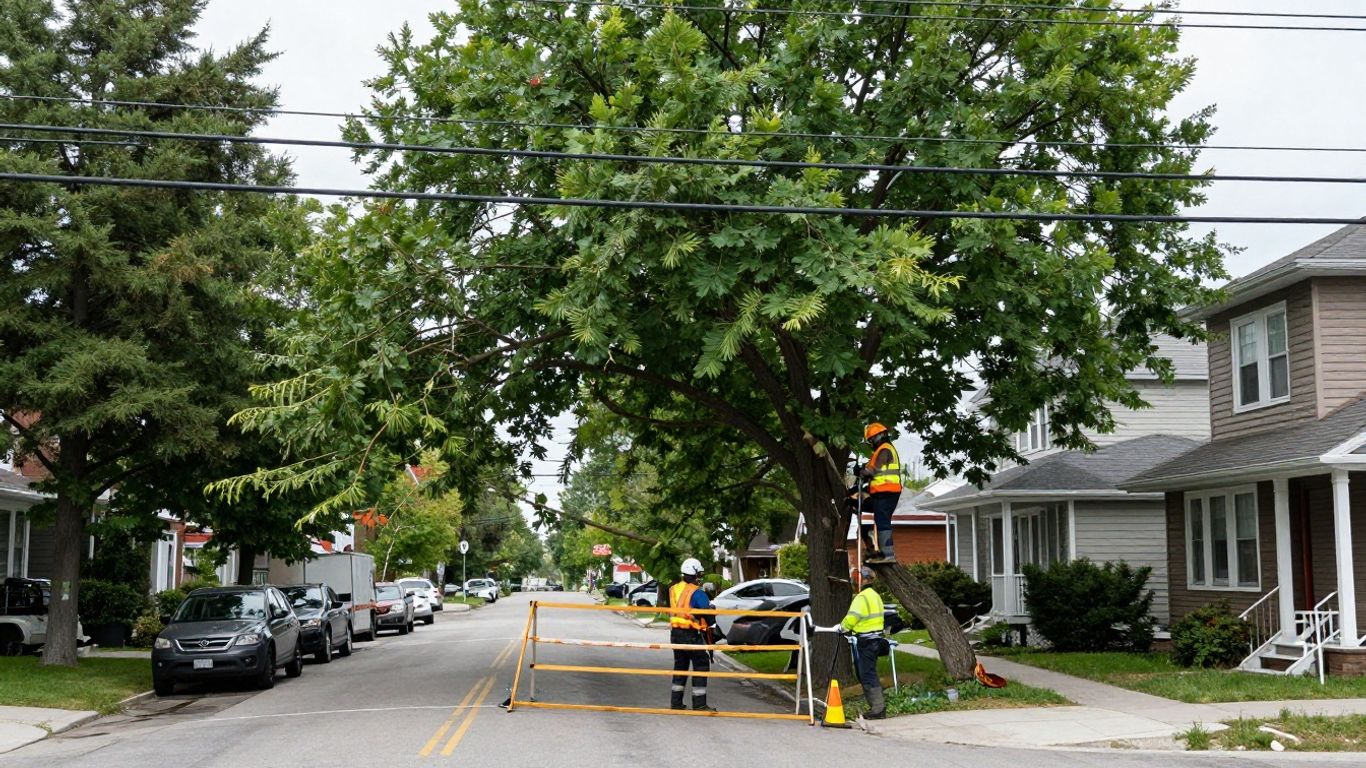
Tree cutting near power lines is not ordinary pruning. A branch can conduct electricity, shift unexpectedly as it falls, or bring a climber, ladder, bucket, or saw into the required approach distance. Even if the tree is on your property, the nearby electrical infrastructure changes the work from routine yard maintenance into a coordinated safety job.
The danger is not limited to direct contact. Electricity can arc across a gap, and a falling limb can pull a service wire from a building or damage a pole. Wet bark, rain, ice, and wind can make movement and visibility less predictable. What looks like a small branch from the ground may also be supporting tension in a larger limb or leaning toward the line.
You also cannot reliably identify every overhead wire from the street. Distribution lines, service drops, telecommunications cables, and other conductors may share a pole or cross the same working area. Before you plan tree trimming around power lines, treat every wire as energized and arrange an assessment rather than guessing from a safe-looking distance.
Who’s Actually Responsible: Toronto Hydro, the City, or the Homeowner?
Responsibility depends on the location and type of line, the tree’s position, and the applicable utility and municipal rules. A tree between poles may be treated differently from a tree interfering with the wire running from a pole to your home. The City of Toronto may also regulate the tree itself, particularly where a protected or significant tree is involved.
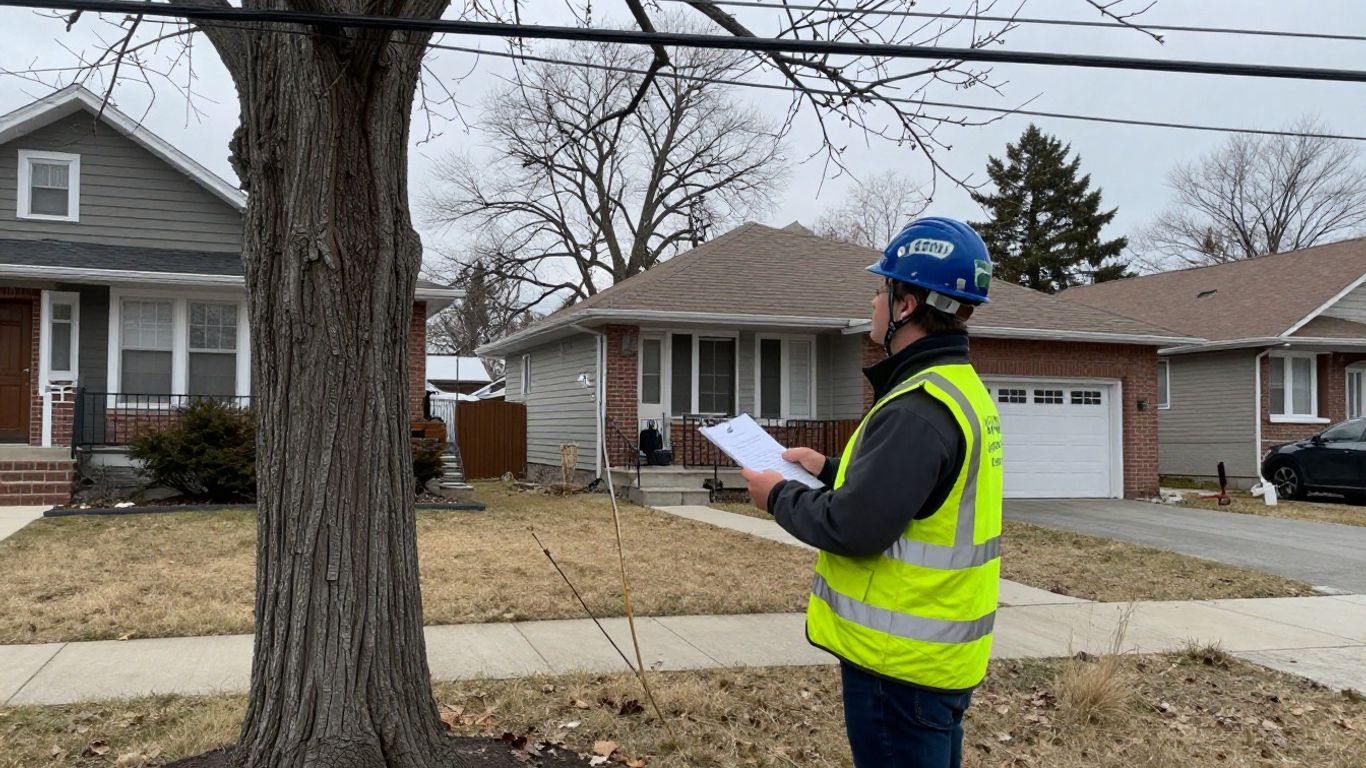
You should not assume that paying for a tree company permits you to work beside a utility line. Start by identifying the hazard, taking photographs from a safe distance, and contacting the appropriate utility or municipal office for direction. A qualified arborist can carry out a risk assessment that looks at both the tree and the line, then help plan work that is legally and practically appropriate.
When You Need Toronto Hydro Instead of a Tree Company
Call Toronto Hydro’s Trouble Dispatch team at 416-542-8000 (press 1) first when a branch or trunk is on a wire, a line is sagging, a pole appears damaged, or the tree is actively threatening electrical service. Keep people and pets away while you wait. A tree company should not be asked to improvise around a line that may need to be isolated, repaired, or made safe by the utility.
If the concern is a healthy tree growing near a line but there is no immediate contact, you can still begin with the utility and an arborist. The utility can clarify its role, while our arborist consulting team evaluates the tree’s structure, likely movement, and pruning options. As a general reference, Toronto Hydro’s official powerline safety page explains why separation and utility coordination matter before work begins.
The Rules Around Tree Trimming Near Power Lines in Toronto
THe city’s rules involve more than electrical clearance. You may need to consider the City’s tree bylaws, private-tree protections, ravine regulations, and whether the work is pruning, removal, or emergency response. The exact requirement can depend on the tree’s size, location, and condition, so a quick online assumption may not be enough.
Before scheduling tree trimming near power lines, gather the property address, photographs, approximate trunk diameter, and details about the line involved. Then verify the municipal requirements and utility process. Toronto’s tree removal permit process for homeowners is a useful place to understand when an application, arborist report, or other documentation may be needed.
Minimum Clearance Distances You Should Know
There is no single clearance number that safely covers every situation. Required separation can vary with voltage, the type of line, the work being performed, weather, equipment, and the direction a branch or tree could move. For that reason, you should not measure a gap with a tape and treat it as permission to proceed.
The following table gives you a practical way to think about the assessment, not a substitute for utility instructions or a site-specific professional decision.
| Situation | Why it matters | Safer next step |
|---|---|---|
| Branches appear to touch a line | Contact may already be creating an electrical hazard | Stay back and contact the utility |
| Tree is within the likely fall zone | The trunk or limbs may reach the conductor if cut | Arrange utility coordination and arborist assessment |
| Service wire runs toward the house | Work may affect the property’s electrical connection | Ask the utility how the line must be made safe |
| Line type is unclear | You may misjudge the hazard or responsible party | Treat it as energized until confirmed otherwise |
The useful rule is simple: do not select a clearance distance based on appearance alone. Let the utility identify its infrastructure and let the arborist design work that keeps people, equipment, and cut material away from the hazard.
Why DIY Tree Removal Near Power Lines Is Never Worth the Risk
DIY tree removal near power lines combines several hazards at once: electricity, height, cutting tools, falling material, and limited escape routes. A homeowner may understand how to cut a small branch but still be unable to predict how the tree will react when a limb is under tension or the crown is weighted toward the wire. One wrong cut can turn a manageable situation into an emergency.
Ladders and pole saws make the risk worse because they extend your reach without giving you control over the tree’s movement. A branch that misses the conductor can still swing back, strike the operator, or damage a roof, vehicle, fence, or service connection. Insurance and municipal consequences can also follow if unpermitted work or damage is involved.
If you are comparing options, the safest option is usually to stop before the first cut. Review what Toronto’s tree bylaw requires to check the regulatory side, and arrange professional advice for the electrical and structural side.
What Happens When a Branch Contacts a Live Wire
A branch touching a live wire can energize the tree, nearby ground, equipment, or a person who is standing close by. Electricity may travel through damp wood, jump through the air, or create a dangerous voltage difference between two points on the ground. You may not hear, see, or smell the danger before someone is injured.
If contact occurs while you are cutting, drop the plan immediately and move away without touching the tree, equipment, fence, or anything connected to it. Do not try to pull the branch away, drive beneath it, or use another tool to separate it. Call the utility or emergency services according to the urgency, warn others away, and wait for qualified personnel.
Signs a Tree Near Your Power Line Needs Attention Now
A tree does not need to be touching a wire to deserve prompt attention. Leaning trunks, cracked unions, dead tops, hanging branches, and roots lifting the soil can all change how the tree behaves in wind or during a cut. Fast-growing branches that are repeatedly approaching a conductor should also be assessed before they become an emergency.
Storm damage can make an ordinary tree much more dangerous. Look from a distance for fresh breaks, split bark, a shifted root plate, or a crown that has changed shape. If you see a wire down, assume it is live and keep everyone away; do not approach simply because the power appears to be out.
A risk assessment is especially sensible when the tree is large, close to a structure, or difficult to view from the ground. A guide to assessing ice storm tree damage can help you recognize hanging hazards and severe structural damage, but it should not encourage you to inspect an unstable tree at close range.
How Professionals Handle Tree Trimming Around Power Lines Safely
Professional tree trimming around power lines starts before anyone climbs or starts a saw. The work area is assessed for the tree’s condition, the line location, access, weather, drop zones, nearby structures, and public exposure. The crew then determines whether utility involvement or a different work plan is needed.
Good planning also means deciding what should not be done. A tree may need directional pruning, sectional removal, or complete removal, but the choice depends on its structure and the available landing areas. Our documented safety standards and training help turn those decisions into controls the crew can discuss and follow on site.
Equipment and Techniques Our Crew Uses Near Live Wires
A qualified crew may use ropes, rigging, insulated or non-conductive systems where appropriate, lowering techniques, and specialized access equipment, but equipment alone does not make energized-line work safe. The method must match the tree, the line, the site, and the utility’s requirements. Never interpret a professional tool as something suitable for homeowner use beside a conductor.
Heritage Tree Care Inc. states that it conducts risk assessments on every site, maintains WSIB coverage for staff, and provides ongoing first aid, CPR, AED, and aerial rescue training. Its documented safety approach includes bi-annual aerial rescue training and a commitment to no shortcuts. Those are process details worth asking about when you request an assessment, rather than relying on a promise that a job will be easy.
The crew should also establish a controlled work zone, communicate clearly, secure cut material, and reassess conditions as the work progresses. If wind, rain, unstable ground, or unexpected line placement changes the risk, the work should pause until the plan is safe again.
A Real Call-Out From Our Files: A Leaning Tree Over a Hydro Line
Imagine arriving to find a mature tree leaning toward a hydro line after several days of wind. From the driveway, the trunk may look intact, but the root plate can be shifting and the upper crown may already be loading the conductor’s side of the tree. Walking underneath to get a closer look would add risk before the actual work has even been planned.
The first step is to establish distance and keep the area clear. The next is to identify the line, inspect the tree from safe viewpoints, and coordinate with the utility before deciding whether pruning, staged removal, or emergency action is appropriate. A leaning tree should never be treated as a normal backyard removal simply because no branch has fallen yet.
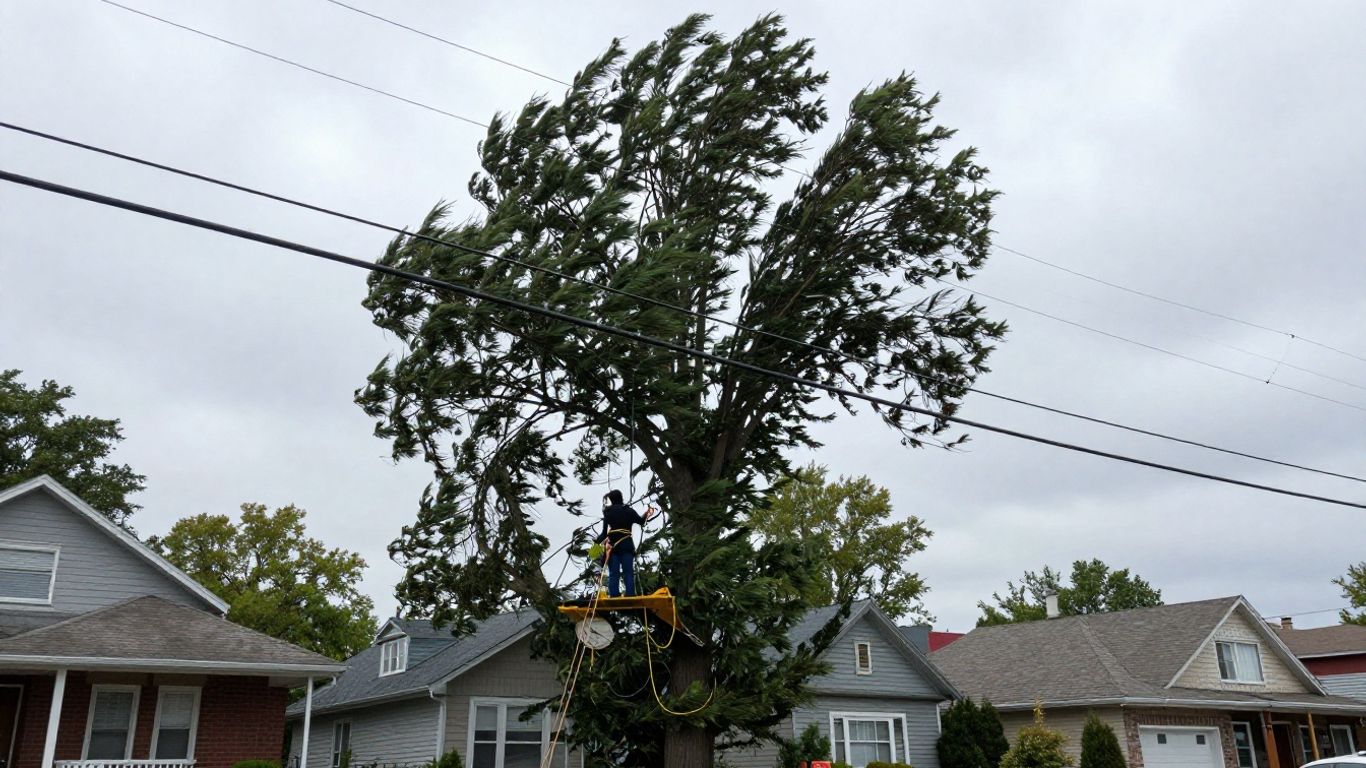
In a situation like this, the homeowner’s most useful contribution is accurate information: when the lean appeared, whether the tree moved during the storm, what structures are nearby, and whether anyone has already touched it. That information helps professionals plan without sending an unprotected person into the hazard zone.
What to Do If a Tree Has Already Fallen on a Power Line
Move everyone away immediately, including pets, and do not touch the tree, wire, vehicle, fence, puddle, or nearby metal object. Stay well back and warn neighbours not to approach. If someone is in a vehicle touching the line, tell them to remain inside unless there is an immediate fire; leaving can create a dangerous path to the ground.
Call Hydro or emergency services for the electrical hazard and describe the location clearly. Do not assume the line is safe because there is no visible spark or because nearby lights are out. Keep roads, driveways, and access routes clear only if you can do so without approaching the fallen material.
Only after the utility has made the electrical situation safe should emergency tree removal be arranged. A certified arborist can then handle tree removal for storm-damaged trees, addressing the trunk, branches, roof or vehicle damage, and remaining hazards. For a broader storm-response checklist, see what to do after a tree falls on a home, while remembering that a power line always takes priority over cleanup.
Permits and Utility Coordination for Tree Removal Near Power Lines
A permit and utility clearance solve different problems. A municipal permit addresses whether the tree may be pruned or removed under the city’s rules; utility coordination addresses the electrical hazard and the work zone. You may need both, and having one does not automatically provide the other.
Start early when the situation is not an emergency. An arborist report, photographs, tree measurements, site details, and a description of the proposed work may be needed for a municipal application. If the tree is dangerous or has already fallen, ask the City and utility what emergency pathway applies rather than relying on an informal decision.
Keep copies of approvals, utility instructions, photographs, and the work plan. This record helps you explain what was assessed and why the work was necessary. It also makes it easier to communicate with neighbours, insurers, and contractors if the work affects shared access or property.
Common Mistakes Homeowners Make With Trees Near Power Lines
Most unsafe decisions begin with a reasonable goal: remove a dead branch, save money, or clear a driveway before the next storm. The trouble is that a homeowner may not see the hidden forces in a tree or know which line carries the greatest risk. A short pause and a proper call can prevent a much larger problem.
Common mistakes include:
- Assuming a wire is harmless because it is thin, insulated, or attached to a service pole.
- Cutting the branch closest to the line first without understanding its weight and tension.
- Using a ladder, metal tool, or pole saw where the operator could enter the line’s hazard area.
- Treating a storm-damaged tree as a cleanup task before the utility confirms the site is safe.
Avoiding these errors does not mean waiting until a branch is already on the wire. Regular inspection and planned pruning can reduce the likelihood of emergency work, while an arborist can identify structural problems you cannot safely evaluate from a ladder or beneath the crown.
FAQs About Tree Cutting and Trimming Near Power Lines in Toronto
Questions about tree trimming near power lines often involve two separate concerns: whether the tree can be worked on safely and whether the proposed work is allowed. Those questions should be answered before you accept a quote or schedule a crew. A clear description of the line, tree, property, and urgency will make the conversation more useful.
You should also be cautious with advice that gives one universal distance or promises that a homeowner can simply “be careful.” Electrical hazards change with the site and the work method. When the tree is close to a conductor, professional assessment and utility direction are more reliable than a general rule found online.
For general background on tree removal costs, emergency services, pruning, and permits, you can browse the tree care FAQ page. Use general information as a starting point, not as permission to enter a dangerous work area.
When to Call a Certified Arborist vs. When to Call Toronto Hydro
Call Hydro first for a fallen or contacting wire, damaged pole, sparking line, severe sag, or any immediate electrical hazard. Keep your distance while reporting it. The utility must address the electrical system before an arborist can safely manage tree material that is entangled with it.
Call a certified arborist when the tree is leaning, diseased, cracked, dead, storm-damaged, or growing toward a line without making contact. An arborist can assess structure, identify likely failure points, and outline pruning or removal options. If the arborist sees that utility coordination is required, that should be part of the work plan rather than an afterthought.
Heritage Tree Care Inc. documents comprehensive tree risk assessments as part of its arborist consulting services, along with tree inventory and tree preservation planning. Those services can help you understand the tree and site before you commit to a method, but they do not replace Toronto Hydro’s role in dealing with electrical infrastructure.
Get a Safe Assessment From Heritage Tree Care Inc.
If you are concerned about tree removal near power lines, do not wait for the next high-wind day to reveal the problem. Keep people away from the hazard, document what you can from a safe position, and arrange a professional assessment that considers the tree, the line, nearby structures, and municipal requirements.
Heritage Tree Care Inc., a certified GTA arborist team, serves the Greater Toronto Area with tree removal, trimming, planting, risk assessment, and emergency services. Its published safety information describes $5 million in general liability coverage, WSIB-covered staff, site risk assessments, and a culture focused on accountability and injury-free operations. You can request an assessment through the Toronto tree services team.
A careful assessment gives you a clearer next step: utility contact, permit research, pruning, staged removal, or no work at all. Call Joseph Gillingham and the Heritage Tree Care Inc. team at 416-458-4745, or get in touch through the contact page – that clarity is worth more than a quick cut made under pressure, especially when a power line is part of the work area.
Conclusion
Tree cutting near power lines requires more than good intentions and a sharp saw: keep your distance, involve Hydro when electrical infrastructure is at risk, check Toronto’s rules, and rely on qualified arborist planning for the tree itself so the work protects your household, property, and surrounding community.
Frequently Asked Questions
Can I trim a tree that is close to a power line?
You should not trim it yourself. Contact the utility for direction and arrange a qualified arborist assessment before any work begins, especially if branches could contact or fall toward the line.
What should I do if a branch is touching a power line?
Stay away from the branch, tree, line, and surrounding objects. Keep other people and pets back, then contact the utility or emergency services so the electrical hazard can be addressed safely.
Are overhead service wires dangerous?
Yes. You should treat every overhead electrical wire as energized until the utility confirms otherwise. A service wire running from a pole to a house can still create a serious shock or arc hazard.
Do I need a permit to remove a tree in Toronto?
Possibly. Requirements depend on factors such as the tree’s size, location, condition, and whether it falls under a protected category. Check current City requirements before arranging non-emergency removal.
Can an arborist make a power line safe?
An arborist can assess and manage the tree, but the utility is responsible for electrical infrastructure and may need to isolate, repair, or otherwise make the line safe before tree work proceeds.
Is tree trimming safer in winter?
Cold weather does not remove electrical or structural hazards. Ice, snow, frozen ground, reduced visibility, and brittle branches can add risk, so the site still needs a professional assessment and appropriate planning.
How far should a tree be from a power line?
There is no single distance that applies to every line and work method. Required separation depends on the electrical system, equipment, tree movement, and site conditions, so follow utility direction and professional advice rather than estimating by eye.
Serving the Greater Toronto Area